

Transition to Cleaner Road Freight Accelerates with Surge in Zero-Emission Truck Adoption
New BloombergNEF and Smart Freight Centre report highlights accelerating transition in road freight sector.
New York, September 18, 2025 – Smart Freight Centre (SFC), together with BloombergNEF (BNEF) highlight their jointly published report, Zero-Emission Commercial Vehicles: Accelerating the Transition 2025 Factbook for Investors ahead of Climate Week NYC. Launched today, the Factbook documents the rapid growth of zero-emission trucking worldwide before next week's leaders' gathering in New York. The analysis underscores both the opportunities and challenges facing the road freight sector as it transitions toward a net-zero future.
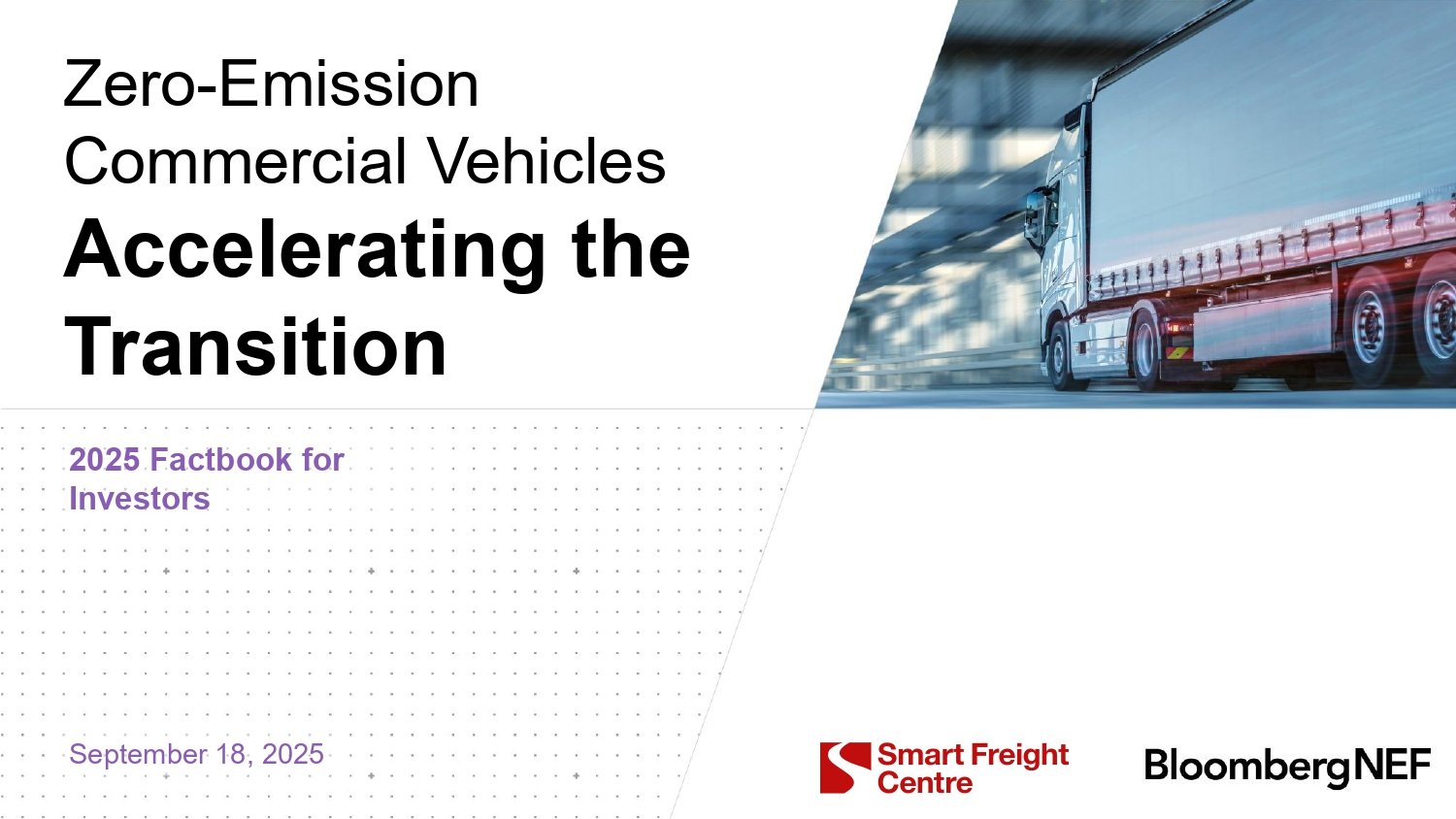
Road freight is central to global economic activity, but its current emissions trajectory is far from aligned with the climate targets set by governments worldwide. The Factbook provides a comprehensive overview of the market for medium- and heavy-duty zero-emission trucks, outlining technology trends, policy developments, and economic competitiveness.
The Factbook demonstrates the imminent viability of e-trucks as a viable asset class in many regions of the world, highlighting the remaining barriers and trends. Members of SFC’s Fleet Electrification Coalition are collectively addressing these challenges with cases in practical implementation such as in India, China, Poland, ZET Scale, and soon a coalition in Brazil.
Key Findings from the Factbook, Include:
- Sales Growth: Global sales of zero-emission trucks reached 89,000 units in the first half of 2025, up 136% year-on-year and nearly matching total sales for all of 2024. The global sales share is on track to reach 4% in 2025.
- Regional Trends: China accounts for more than 90% of global sales, widening its lead. Europe continues to grow strongly, while sales in the US have sharply declined due to policy reversals.
- Technology Outlook: Battery-electric trucks dominate, making up 97% of sales globally. Fuel cell truck sales remain concentrated in China and are declining.
- Economics: Electric trucks can be cost-competitive in some regions with favourable electricity prices and high diesel costs, particularly in China and parts of Europe. In the US, cost parity remains limited to areas with the lowest electricity costs.
- Battery Market: Prices for truck batteries in China fell to $90 per kilowatt-hour in 2024, driven by adoption of lithium iron phosphate (LFP) chemistry and domestic overcapacity. Global truck manufacturers now offer battery warranties exceeding 600,000 kilometers and as high as 1.2 million kilometers
- Policy Support: European governments have earmarked $4 billion in funding for truck charging infrastructure. Policy backing for heavy-duty vehicles is increasing worldwide, although progress is uneven across countries.
The Road Ahead
Despite recent changes in the truck manufacturing landscape and some e-truck startups and manufacturers lagging in their 2030 sales targets, overall adoption continues to accelerate. Early adopters are finding ways to mitigate operational and vehicle and battery re-sale value risks, with secondary applications such as stationary storage and recycling creating new value streams for this nascent ecosystem. Leading shippers and carriers worldwide are implementing zero Emission trucks at pace, lifting long standing barriers creating efficiency and resilience in their operation.
Achieving zero-emission logistics by 2050 requires the rapid decarbonization of road freight. This report shows that the transition is not only underway but accelerating. Governments, industry, and financiers are working together to channel demand for zero emission trucks and close regional gaps to ensure that heavy-duty trucking contributes to a 1.5°C climate pathway.”

Christoph Wolff
Chief Executive Officer, Smart Freight CentreThe zero-emission truck market is expanding at an unprecedented pace, with China leading the charge and Europe showing strong momentum. While challenges remain – particularly around infrastructure and policy consistency – the economic case for electric trucks is becoming increasingly clear. Our research shows that cost competitiveness is no longer a distant prospect but a reality in many markets.

Albert Cheung
Deputy CEO, BloombergNEFAbout Smart Freight Centre
Smart Freight Centre is a globally active non-profit organization dedicated to climate action in the freight sector. SFC works with members and partners across the logistics ecosystem to measure, reduce, and track greenhouse gas emissions. Our mission is to accelerate the reduction of logistics emissions to achieve a zero-emission global logistics sector by 2050 or earlier, in line with 1.5°C pathways.
About BloombergNEF
BloombergNEF (BNEF) is a strategic research provider covering global commodity markets and the disruptive technologies driving the transition to a low-carbon economy. Our expert coverage assesses pathways for the power, transport, industry, buildings and agriculture sectors to adapt to the energy transition. We help commodity trading, corporate strategy, finance and policy professionals navigate change and generate opportunities.